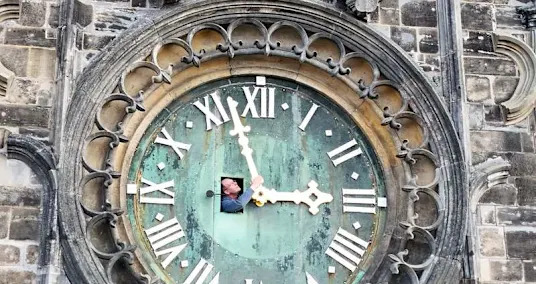
Clocks across the majority of European countries are set to go forward by one hour early on Sunday as the continent moves to daylight saving time, also known as summer time.
Clocks in most European nations including Germany advance by one hour at 2 am (0100 GMT) to 3 am, heralding longer evenings and brighter days.
This means that for the coming months parts of Europe will be on Central European Summer Time (CEST), before moving back to Central European Time (CET) in the autumn, when clocks go back again by an hour on October 25.
The aim of the change is to make better use of daylight in the shorter days of the winter in the northern hemisphere.
The signal for the automatic changeover of the clocks in Germany comes from the Federal Institute of Physics and Metrology (PTB) in the northern city of Braunschweig, also known as Brunswick in English.
The institute's experts ensure that radio-controlled clocks, station clocks and many industrial clocks are supplied with the signal via a long-wave transmitter called DCF77 in Mainflingen near Frankfurt.
LATEST POSTS
- 1
 Step by step instructions to Analyze Senior Insurance Contracts Really.
 - 2The most effective method to Pick a Campervan That Offers Something else for Less
- 3Christopher Nolan's 'The Odyssey' trailer: See Anne Hathaway, Matt Damon and Tom Holland in 1st look at movie
- 4Figure out How to Get a good deal on Your Rooftop Substitution Venture
- 5Internet Bookkeeping Programming for Consultants



- Exploring Programming Greatness: A Survey of \Easy to use Connection points\
- Faulty glucose monitors linked to 7 deaths and more than 700 injuries, FDA warns
- In these U.S. groups, deaths now exceed births. What’s happening?
- Extreme Manual for Purchasing Your Next Truck
- Ultra-Orthodox protests erupt across Israel on haredi IDF enlistment day
- Picking the Right Air Purifier for Your Home
- Hezbollah uses ambulances, paramedic uniforms, as disguise for terrorist activity, IDF says
- Longtime United Launch Alliance CEO Tory Bruno resigns from space company. 'Finished the mission I came to do.'
- A volcanic eruption may have catalyzed the plague's arrival in Europe, study suggests